
Obsolete OEM Air Compressor Oils: How to Find the Right Replacement Without Risk
Posted by IAP on 12/29/2025
If you’re running an older air compressor, you may eventually encounter a frustrating problem: the OEM oil you’ve relied on for years is suddenly obsolete or discontinued. This often happens without much warning, leaving maintenance teams scrambling for answers, and risking costly downtime if the wrong substitute is used.
The reality is that not all compressor oils are interchangeable. Choosing a “close enough” alternative can lead to seal damage, varnish buildup, shortened oil life, or even airend failure. This is especially true when replacing legacy OEM lubricants with unique formulations.
This guide explains why OEM compressor oils become obsolete, the risks of improper substitution, and how to confidently select a safe replacement, using Sullair 24KT and IAP’s Syngold 240 as a real-world example. For a broader overview of oil types, maintenance considerations, and selection guidance, reference IAP’s Air Compressor Oil Guide.
Why OEM Air Compressor Oils Become Obsolete
OEM compressor oils don’t disappear because the compressor itself is unsafe or outdated. In most cases, obsolescence is driven by changes on the manufacturing or supply side, not the equipment.
Common reasons include:
- Reformulation or consolidation of lubricant product lines
- Regulatory or material changes affecting certain additives or base stocks
- Declining demand for oils tied to legacy compressor platforms
- OEM mergers or supplier changes that eliminate older SKUs
When an oil becomes obsolete, it usually means the OEM no longer produces or supports that specific formulation, not that the compressor suddenly requires replacement. The challenge lies in identifying a lubricant that matches the original oil’s performance characteristics, not just its viscosity grade.
The Risk of Improper Oil Substitution
One of the most common mistakes when an OEM oil is discontinued is assuming that any synthetic oil with a similar viscosity will work. In industrial compressed air systems, that assumption can be expensive.
Improper oil substitution can lead to:
- Chemical incompatibility between base stocks
- Seal swelling or shrinkage, resulting in leaks
- Accelerated oxidation or varnish formation
- Reduced oil life and increased maintenance intervals
- Premature airend wear or failure
These risks are magnified in rotary screw compressors that operate continuously under high heat and pressure. Even short-term use of the wrong lubricant can create long-term reliability issues.
This is why replacement selection should focus first on oil chemistry and application compatibility, not price or convenience.
How to Identify a Safe Replacement for an Obsolete OEM Oil
When replacing an obsolete compressor oil, a structured evaluation matters. The goal is to match how the oil performs inside the compressor, not just what it looks like on paper.
Key factors to consider include:
- Base oil chemistry (PAO, silicone-based, food-grade, etc.)
- Operating temperature range and thermal stability
- Compressor type and duty cycle
- Compatibility with existing seals, coatings, and internal components
It’s also critical to avoid mixing oils unless compatibility is explicitly confirmed. In many cases, switching to a new formulation requires draining the old oil completely and following appropriate flushing practices.
If you’re comparing OEM and aftermarket options, start by browsing IAP’s full selection of air compressor oils designed specifically for compressed air duty cycles.
Obsolete OEM Example: Sullair 24KT
A common legacy lubricant many operators still search for is Sullair 24KT. This oil was widely used in older Sullair rotary screw compressors but is no longer available from the OEM.
Sullair 24KT Oils No Longer Available
The following Sullair 24KT SKUs are now obsolete:
- 02250051-150 – 24KT Fluid, 55 Gallon
- 02250045-655 – 24KT Fluid, 5 Quart
- 02250051-153 – 24KT Fluid, 5 Gallon
As availability declined, many operators were left unsure whether they could safely substitute another synthetic compressor oil, or whether doing so would risk internal damage.
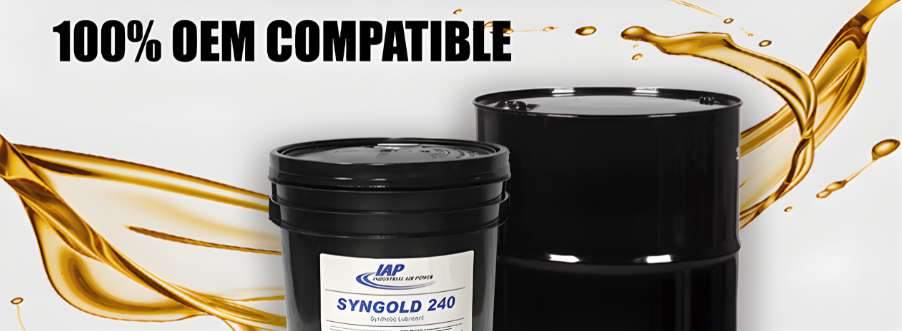
IAP Direct Replacement for Sullair 24KT: Syngold 240
To address this gap, IAP offers a direct replacement option designed for applications where Sullair 24KT was originally specified.
Why Syngold 240 Is a Suitable Replacement
Syngold 240 is a silicone-based, full synthetic air compressor lubricant engineered to deliver stable performance in demanding rotary screw applications. It is formulated to meet the operating characteristics required by compressors originally designed for 24KT-type oils.
Key benefits include:
- High thermal stability for continuous-duty operation
- Consistent viscosity across temperature ranges
- Compatibility with legacy compressor systems
- Reliable availability through IAP’s controlled supply chain
Most importantly, Syngold 240 is positioned as a direct replacement, not a generic substitute. That distinction matters when you’re protecting uptime and avoiding trial-and-error substitutions that can lead to seal damage or shortened oil life.
Best Practices When Switching from an Obsolete OEM Oil
Even with the correct replacement oil selected, how you make the transition matters.
Recommended best practices include:
- Fully drain the existing oil before refilling
- Avoid mixing old and new formulations unless compatibility is confirmed
- Monitor oil condition during the first service interval after switching
- Document the replacement oil in maintenance records for future reference
If residue or varnish is present during a changeover, IAP offers cleaners and degreasers designed for compressor lubrication systems.
Get Help Confirming the Right Direct OEM Replacement
Not every obsolete oil has a one-to-one replacement, and not every compressor application is the same. If you’re unsure about compatibility, operating conditions, or conversion considerations, you can contact IAP to verify the right lubricant for your compressor model.
For repeat purchasing, faster checkout, and access to business pricing, you can also create an IAP account.
Safety Notes
- Always follow Lockout/Tagout (LOTO) procedures and fully depressurize the system before performing maintenance.
- Use OEM-rated or approved replacement components and lubricants only; never bypass safety devices.
- Electrical diagnostics and controls work should be performed by qualified personnel.