
Thermal Transfer Products: Performance-Driven Air-Cooled and Water-Cooled Heat Exchangers
Posted by IAP on 02/10/2026
Heat is one of the fastest ways compressed air systems lose efficiency, often without anyone noticing. When temperatures rise:
- Oil life is shortened
- Energy consumption increases
- Reliability quietly erodes long before the compressor ever shuts down
Obviously, operations aim to avoid the byproducts of high temps. So, the question becomes: how?
The baseline framework is straightforward:
Heat exchangers need to be properly selected and matched to the application.
- Correct cooling = efficient compressor operation = predictable maintenance and easier downstream issue management
Cooling performance plays a direct role in how consistently a system runs.
- Undersized or mismatched cooling = problems compound quickly across the system
To control these risks, Thermal Transfer Products designs performance-driven air-cooled and water-cooled heat exchangers for industrial compressed air systems.


Thermal Transfer Products: Built for Industrial Heat Control
Bottom Line
Duty cycles vary. Ambient temperatures fluctuate. Loads change over time.
In compressed air applications, heat control directly impacts:
- Efficiency
- Reliability
- Maintenance frequency
The Goal
Consistent cooling performance → Stable compressor operation is supported day after day
To achieve this, heat exchangers must be built to handle inevitable variables without becoming a limiting factor.
Accounting for Realistic Operating Margins, Not Narrow Conditions
Heat exchangers are designed around how industrial systems actually run, not idealized conditions. This approach becomes especially important as systems scale, runtimes increase, or environmental conditions shift.
Thermal Transfer Products focuses on one critical function in compressed air systems: effective heat control under real operating conditions. Rather than producing generic cooling components, TTP designs air-cooled and water-cooled heat exchangers engineered to manage real-world thermal loads and support long-term system health.
Multiple cooling technologies and configuration options allow systems to be matched to the application instead of forcing compromises.
When heat control is handled correctly:
- Compressor stress is reduced
- Oil life is extended
- Maintenance becomes more predictable
This application-driven design philosophy allows Thermal Transfer heat exchangers to support consistent performance in demanding compressed air environments.
Engineering Approach: Prevent Cooling Limitations from Becoming System Limitations
Effective heat control depends on how well a heat exchanger performs under real operating variables, not ideal conditions.
In industrial compressed air systems, those variables include:
- Fluctuating ambient temperatures
- Changing duty cycles
- Continuous operation under load
- Space, airflow, or water constraints
Increased runtime, production expansion, or higher ambient temperatures can quickly expose cooling designs that were never intended to operate beyond narrow conditions.
TTP engineers heat exchangers with operating margins that account for these variables over time. Designs are built to maintain stable, repeatable cooling performance even as systems evolve.
Effective heat exchange = controlled temperatures → reduced system stress → more predictable performance
Heat exchangers built with real operating margins prevent cooling limitations from becoming system limitations. This disciplined approach supports long-term system stability instead of short-term thermal correction.
Understanding Heat Exchanger Types and Cooling Technologies
| Application Area | Cooling Medium | Technology Type | Typical Role in Compressed Air Systems |
|---|---|---|---|
| Compressor oil cooling | Air | Tube-and-fin, brazed aluminum | Oil temperature control in rotary screw and industrial systems |
| Compressor oil cooling | Water | Shell and tube, brazed plate | High-load or high-ambient oil cooling |
| Compressed air cooling | Air | Aftercoolers, fan-cooled units | Reduce discharge air temperature and moisture |
| Compressed air cooling | Water | Shell and tube aftercoolers | Consistent air cooling in demanding environments |
| Integrated fluid conditioning | Air or water | Pump / filter / cooler assemblies | Centralized thermal and contamination control |
Thermal Transfer Products designs heat exchangers across these cooling technologies to support both compressed air and oil cooling applications. Configuration, materials, and performance characteristics vary based on flow rates, operating temperatures, space constraints, and system demands.
Understanding how these technologies are categorized provides a baseline for evaluating whether air-cooled or water-cooled solutions are best suited for a specific operating environment.
Thermal Transfer Heat Exchanger Solutions for Compressed Air Systems
Because compressed air systems do not operate in a single, fixed environment, cooling requirements change based on:
- Facility layout
- Production demands
- Available utilities
- Operating expectations
These environmental considerations are unique to each operation. This is why heat exchanger solutions are intended to integrate into compressed air systems as functional components, not secondary accessories.
Cooling treated as part of the system design = Compressors operate more reliably + downstream equipment benefits from more stable conditions
Rather than forcing a single cooling method across diverse applications, Thermal Transfer offers multiple solution paths that allow systems to be designed or retrofitted appropriately. TTP supports compressed air applications with both air-cooled and water-cooled heat exchanger solutions designed to accommodate a wide range of operating conditions.
This flexibility allows facilities to maintain consistent cooling performance as conditions change without relying on workarounds or oversizing.
Air-Cooled vs Water-Cooled Heat Exchangers: Choosing the Right Approach
There is no single “best” heat exchanger for compressed air systems. The right approach depends on how the system operates, the environment it runs in, and what the facility needs from it over time.
The decision typically comes down to air-cooled or water-cooled heat exchangers, each serving a distinct role.
Air-Cooled Heat Exchangers
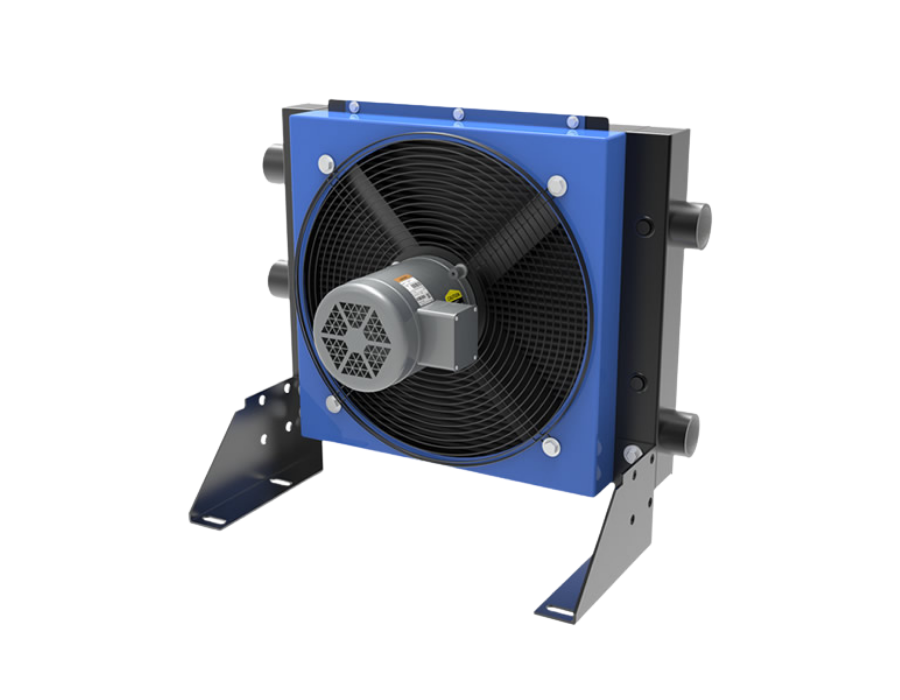
How do air-cooled heat exchangers work?
Air-cooled heat exchangers in compressed air systems are most often referred to as air-cooled aftercoolers. Air-cooled heat exchangers remove heat using ambient air and forced airflow, cooling compressed air or compressor oil depending on system design. They are commonly used in facilities where water access is limited or where installation simplicity is a priority.
Air-cooled solutions are often a good fit when:
- Ambient temperatures are moderate
- Adequate airflow is available
- Water access is limited or undesirable
- Simpler installation and maintenance are preferred
Air-cooled heat exchangers are widely used across many industrial environments, but their performance is directly influenced by surrounding air conditions. As ambient temperatures rise or airflow becomes restricted, cooling effectiveness can decline.
Aftercoolers
In compressed air systems, air-cooled aftercoolers are most commonly associated with rotary screw air compressors. In these systems, aftercoolers play a key role in reducing discharge air temperature and removing moisture before air moves downstream.
Aftercoolers can be used with reciprocating compressors in certain larger configurations, but this is far less common. In most industrial applications, aftercoolers are primarily applied within rotary screw compressor systems where continuous operation and heat management are critical.
→ Explore Air-Cooled Heat Exchangers
Water-Cooled Heat Exchangers
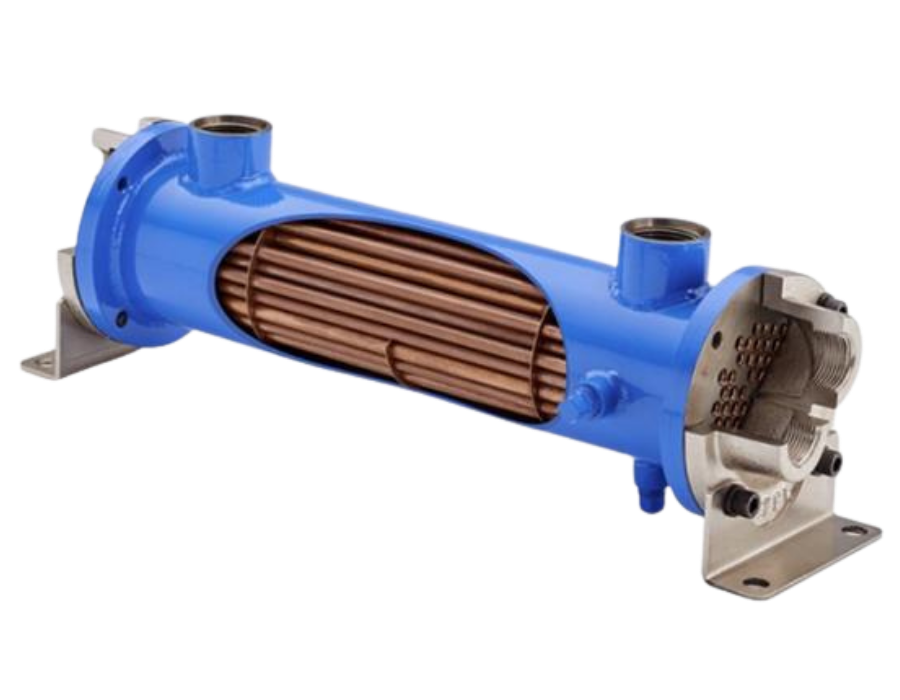 How do water-cooled heat exchangers work?
Water-cooled heat exchangers, also referred to as oil coolers, use a liquid cooling medium to remove heat more consistently, especially in demanding conditions.
In compressed air applications, water-cooled oil coolers are commonly built using shell-and-tube designs, though not all oil coolers serve the same function.
Shell-and-Tube Oil Coolers vs Hydraulic Oil Coolers
While some heat exchanger designs may appear similar across hydraulic and compressed air systems, proper selection depends on operating temperatures, oil type, flow rates, and duty cycle. Matching the cooler to the application ensures reliable heat control without introducing unnecessary restrictions or maintenance challenges.
Shell-and-Tube Oil Coolers
Water-cooled heat exchangers used in compressed air systems are most commonly shell-and-tube oil coolers. These designs circulate compressor oil through a tube bundle while water flows around the tubes to remove heat efficiently and consistently. Shell-and-tube oil coolers are widely used in rotary screw compressor applications due to their durability, serviceability, and ability to handle continuous operation.
Hydraulic Oil Coolers
Hydraulic oil coolers, while often similar in construction, are typically designed for hydraulic power units and fluid power systems. These coolers may prioritize different pressure ratings, flow characteristics, and operating profiles compared to compressor oil cooling applications.
Water-cooled solutions are often selected when:
- Ambient temperatures are high
- Compressors run continuously or under heavy load
- Tighter temperature control is required
- A reliable water source is available
Because water temperature is typically more stable than ambient air, water-cooled heat exchangers often deliver more consistent cooling performance in high-ambient or high-load applications where operating conditions fluctuate and tighter temperature control is required.
This makes them well suited for high-duty-cycle applications where heat control cannot fluctuate.
→ Explore Water-Cooled Heat Exchangers
Quick Recap
Choosing between air-cooled and water-cooled heat exchangers is not about preference. It is about matching the cooling method to operating realities.
- Stable conditions = air-cooled may be sufficient
- High heat loads or harsh environments = water-cooled may be necessary
When the cooling approach aligns with how the system actually runs:
→ Compressor efficiency improves
→ Temperatures stay controlled
→ System performance becomes more predictable
→ Long-term reliability improves
Matching Heat Exchanger Design to Real Operating Conditions
Selecting the correct cooling approach is only part of the decision. Heat exchanger design must also be evaluated against how the system is expected to operate long term.
Key factors include:
- Cooling capacity relative to actual thermal load
- Airflow or water flow availability and stability
- Material selection based on environment and fluid type
- Physical configuration and fit within the system
- Expected runtime and future operating changes
Matching design to operating reality helps ensure cooling performance remains consistent over time rather than degrading as conditions shift.
When heat exchanger selection accounts for these factors:
- Compressors operate more efficiently
- Temperatures remain controlled
- Maintenance planning becomes proactive instead of reactive
Thermal Transfer Replacement Components and Cooling System Support
No cooling system can maintain efficiency without upkeep. Over time, heat exchangers and supporting components require maintenance or replacement to preserve performance.
Thermal Transfer supports compressed air systems not only through complete heat exchanger solutions, but also through replacement components that maintain original cooling intent. These components play a critical role in sustaining performance throughout the system lifecycle.
IAP carries hundreds of Thermal Transfer replacement components covering cooling cores, airflow, controls, system hardware and more, with exact-fit options across a wide range of compressor platforms.
Exact-fit replacement components:
- Preserve cooling performance
- Reduce installation issues
- Prevent unintended system changes that can introduce new inefficiencies
Accessing Thermal Transfer Products Through Industrial Air Power
Once cooling requirements are understood and the appropriate solution path is identified, sourcing becomes the next consideration.
Industrial Air Power provides online, centralized access to Thermal Transfer heat exchangers and replacement components, allowing buyers to evaluate available configurations, review options, and move forward without unnecessary sales friction.
When new equipment or replacement parts are needed, sourcing becomes the next consideration. Through IAP’s online catalog, access Thermal Transfer’s performance-driven heat exchangers with the ability to review options, compare configurations, and source the right solution without unnecessary friction in the purchasing process.
→ Shop Thermal Transfer Heat Exchangers
→ Shop Thermal Transfer Replacement Parts
Designing for Heat Control = Designing for Reliability
To recap, heat control plays a defining role in compressed air system performance.
See exactly how this plays out across two different scenarios:
Scenario A:
Cooling performance cannot maintain stability as operational variables fluctuate → problems compound quickly across the system
Scenario B:
Cooling is properly engineered into the system design → stable operation as conditions fluctuate → compressors run more efficiently → maintenance becomes more predictable → system reliability improves
Don’t Leave Heat Management Up to Chance
Thermal Transfer Products designs heat exchangers to help avoid Scenario A, no matter when or what conditions your operation faces.
With the right cooling approach in place, facilities are better positioned to maintain performance, control operating costs, and support long-term system reliability.
If you need additional help, our compressed air equipment experts are available at (414) 422-1717.