
Description
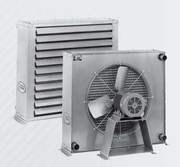
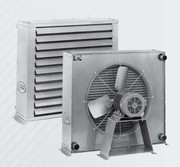
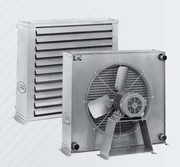
AOVH-10 Fan-Driven Air-Oil Cooler
The AOVH-10 industrial air-oil cooler provides dependable heat removal for medium-sized hydraulic power units, gearboxes, and continuous-duty machinery. With increased cooling capacity compared to the AOVH-5, this model is well-suited for systems that require stable operating temperatures and reliable thermal protection during steady or intermittent operation.
AOVHR Two-Pass & Relief Bypass Option
This model can also be configured as an AOVHR two-pass cooler with an integral relief bypass valve. The AOVHR option routes the oil through the cooler twice for improved heat transfer while the built-in bypass valve protects the system from high backpressure, particularly during cold starts or when viscosity is elevated.
- Two-pass oil flow: Doubles fluid exposure to the cooling core for increased heat rejection.
- Integral relief bypass: Available in typical 30 psi or 60 psi settings (model dependent) to limit backpressure.
- Typical flow range: For AOVHR-10-2, approximately 4–60 GPM depending on fluid viscosity and operating conditions.
- Same ratings as AOVH: 300 psi maximum operating pressure and 400°F maximum operating temperature.
AOVH-10 Specifications
- Model: AOVH-10
- Series: AOVH industrial air-cooled oil cooler
- Cooling Type: Fan-driven, air-cooled oil cooler
- Maximum Operating Pressure: 300 psi
- Maximum Operating Temperature: 400°F
- Dimensions (in): A: 9.50, B: 19.00, C: 6.56, D: 13.12, E: 19.49, F: 10.50, G: 12.50, K: 4.44, L: 8.88, M: 7.94, N: 15.88, P: 21.00
- Connections: 1-1/2" NPT, 1-7/8-12UN SAE
- Approximate Net Weight: 78 lb
AOVH / AOVHR Series Overview
Thermal Transfer AOVH and AOVHR industrial air-cooled oil coolers are engineered for hydraulic and lubrication systems that require reliable heat rejection in a compact footprint. Typical applications include fluid power systems, gear drives, injection molding machines, machine tools, torque converters, and hydraulic presses. The AOVH series provides one-pass oil flow through the core, while the AOVHR series adds a two-pass circuit and integral relief bypass for systems that need additional protection and enhanced cooling performance.
Key Features & Applications
- High-efficiency fin-and-tube air-oil heat exchanger for demanding industrial duty.
- Supports low to medium hydraulic and lube oil flows with manageable pressure drop.
- Fan-driven cooling for consistent performance independent of ambient airflow.
- Compact footprint for simplified mounting on or near hydraulic power units.
- AOVH one-pass and AOVHR two-pass circuits to match system heat load and plumbing layout.
- Ideal for hydraulic power units, industrial gearboxes, mobile equipment, and lubrication systems.
Construction, Ratings & Materials
Pressure & Temperature Ratings
| Maximum Operating Pressure | 300 PSI |
|---|---|
| Maximum Operating Temperature | 400°F |
Standard Materials of Construction
| Tubes | Copper |
|---|---|
| Fins | Aluminum |
| Turbulators | Steel |
| Fan Blade | Aluminum with steel hub |
| Fan Guard | Zinc-plated steel |
| Cabinet | Steel with baked enamel finish |
| Manifolds | Steel |
| Connections | Steel |
Model Weights
| Model | Net Weight (lb) |
|---|---|
| AOVH / AOVHR-5 | 67 |
| AOVH / AOVHR-10 | 78 |
| AOVH / AOVHR-15 | 90 |
| AOVH / AOVHR-20 | 110 |
| AOVH / AOVHR-25 | 157 |
| AOVH / AOVHR-30 | 190 |
| AOVH / AOVHR-35 | 315 |
| AOVH / AOVHR-40 | 350 |
AOVHR Two-Pass Flow Ranges
| Two-Pass Model | Typical Flow Range (GPM) |
|---|---|
| AOVHR-5-2 | 4–50 |
| AOVHR-10-2 | 4–60 |
| AOVHR-15-2 | 4–60 |
| AOVHR-20-2 | 4–80 |
| AOVHR-25-2 | 4–80 |
| AOVHR-30-2 | 4–80 |
| AOVHR-35-2 | 6–80 |
| AOVHR-40-2 | 8–80 |
Installation & Piping Notes
Fan rotation is clockwise when facing the motor shaft. AOVH and AOVHR coolers are normally mounted horizontally with airflow drawn through the core. Consult dimensional drawings for mounting hole placement, motor bracket orientation (AOVH-5 and AOVH-10 brackets are rotated 90°), and fan projection.
One-pass AOVH models typically route oil from the lower connection to the upper connection. Two-pass AOVHR models route oil in and out on the same side, with an internal cap directing flow through both passes. Always confirm flow direction before installation.
Lubrication & Motor Bearing Maintenance
Standard motors include sealed ball bearings requiring no initial greasing. For long-term reliability, regreasing intervals depend on operating conditions:
| Operating Condition | Recommended Grease Interval |
|---|---|
| Typical duty (up to ~5,000 hours/year) | Every 5 years |
| Continuous normal service | Every 2 years |
| Seasonal or intermittent use | Every 1 year |
| High heat, dust, moisture, or vibration | Every 6 months |
Note: Over-lubrication may damage motor bearings. Follow manufacturer instructions.
Viscosity Correction Factors (Cv)
Sizing performance is based on oil leaving the cooler at approximately 50 SSU. Use the following multipliers to estimate performance adjustments when using different oil viscosities or temperatures:
| Avg. Oil Temp (°F) | Mineral Oil (SAE) | 50/50 Ethylene Glycol/Water | ||||
|---|---|---|---|---|---|---|
| SAE 5 | SAE 10 | SAE 20 | SAE 30 | SAE 40 | 50/50 Mix | |
| 100 | 1.14 | 1.22 | 1.35 | 1.58 | 1.77 | 1.11 |
| 150 | 1.01 | 1.05 | 1.11 | 1.21 | 1.31 | 1.02 |
| 200 | 0.99 | 1.00 | 1.01 | 1.08 | 1.10 | 0.96 |
| 250 | 0.95 | 0.98 | 0.99 | 1.00 | 1.00 | 0.95 |
Standard TEFC Motor & Fan Data
| Model | CFM | dB(A) | Motor HP | Volts | Phase | Full Load Amps | Hz | NEMA Frame | RPM | Type | Circuit | Thermal OL | Bearing |
|---|---|---|---|---|---|---|---|---|---|---|---|---|---|
| AOVH-5 | 780 | 85 | 1/2 | 115/208-230 | 1 | 7.4 / 3.9-3.7 | 60 | 48 | 3450 | TEFC | C | No | Ball |
| AOVH-10 | 1110 | 85 | 1/2 | 115/208-230 | 1 | 7.4 / 3.9-3.7 | 60 | 48 | 3450 | TEFC | A | No | Ball |
| AOVH-15 | 1590 | 91 | 1/2 | 115/208-230 | 1 | 7.4 / 3.9-3.7 | 60 | 48 | 3450 | TEFC | A | No | Ball |
| AOVH-20 | 2168 | 91 | 1/2 | 115/208-230 | 1 | 7.4 / 3.9-3.7 | 60 | 48 | 3450 | TEFC | C | No | Ball |
| AOVH-25 | 3000 | 81 | 1 | 115/208-230 | 1 | 12.4 / 6.5-6.2 | 60 | 56 | 1725 | TEFC | C | No | Ball |
| AOVH-30 | 4095 | 84 | 1 | 115/208-230 | 1 | 12.4 / 6.5-6.2 | 60 | 56 | 1725 | TEFC | C | No | Ball |
| AOVH-35 | 5921 | 89 | 3 | 208-230/460 | 3 | 9.0-8.6 / 4.3 | 60 | 182T | 1725 | TEFC | D | No | Ball |
| AOVH-40 | 9609 | 91 | 3 | 208-230/460 | 3 | 9.0-8.6 / 4.3 | 60 | 182T | 1725 | TEFC | D | No | Ball |
Explosion-Proof Motor Options
Explosion-proof motor configurations are available for hazardous locations (Class I Group D; Class II Groups F & G). Always consult the motor nameplate to confirm final ratings.
| Model | CFM | dB(A) | HP | Volts | Phase | Full Load Amps | Hz | NEMA Frame | RPM | Type | Circuit | Thermal OL | Bearing |
|---|---|---|---|---|---|---|---|---|---|---|---|---|---|
| AOVH-5 | 780 | 85 | 1/2 | 115/230 | 1 | 7.4 / 3.7 | 60 | 48 | 3450 | FC | C | Yes | Ball |
| AOVH-10 | 1110 | 85 | 1/2 | 115/230 | 1 | 7.4 / 3.7 | 60 | 48 | 3450 | FC | C | Yes | Ball |
| AOVH-15 | 1590 | 91 | 1/2 | 115/230 | 1 | 7.4 / 3.79 | 60 | 48 | 3450 | FC | C | Yes | Ball |
| AOVH-20 | 2168 | 91 | 1/2 | 115/230 | 1 | 7.4 / 3.79 | 60 | 48 | 3450 | FC | C | Yes | Ball |
| AOVH-25 | 3000 | 81 | 1 | 115/230 | 1 | 12.4 / 6.2 | 60 | 56 | 1725 | FC | C | Yes | Ball |
| AOVH-30 | 4095 | 84 | 1 | 115/230 | 1 | 12.4 / 6.2 | 60 | 56 | 1725 | FC | C | Yes | Ball |
| AOVH-35 | 5921 | 89 | 3 | 230/460 | 3 | 8.6 / 4.3 | 60 | 182T | 1725 | FC | D | No | Ball |
| AOVH-40 | 9609 | 91 | 3 | 230/460 | 3 | 8.6 / 4.3 | 60 | 182T | 1725 | FC | D | No | Ball |
Frequently Asked Questions
AOVH-10 Fan-Driven Air-Oil Cooler
▶️ Question: When should I choose the AOVH-10 instead of the smaller AOVH-5?
Answer: The AOVH-10 is a better choice when your hydraulic or lube oil system generates more heat than a compact cooler can handle. If you’re running higher duty cycles, slightly larger hydraulic power units, or small-to-mid gearboxes that run for longer hours, the AOVH-10 provides more cooling surface area and airflow than the AOVH-5, helping keep oil temperature under control and extending component life.
▶️ Question: What is the difference between the AOVH-10 and the AOVHR-10-2 two-pass version?
Answer: The AOVH-10 is a one-pass cooler—oil flows through the core once from the lower port to the upper port. The AOVHR-10-2 routes oil through the core twice and includes an integral relief bypass valve. The two-pass design increases cooling effectiveness for a given footprint, while the bypass valve protects against excessive backpressure during cold starts or when oil viscosity is high. The AOVHR-10-2 typically covers about 4–60 GPM, making it ideal for return-line or dedicated cooling circuits that see varying flow and temperature conditions.
▶️ Question: What kind of systems and fluids can the AOVH-10 be used with?
Answer: The AOVH-10 is designed for common hydraulic oils, lube oils, and similar petroleum-based fluids used in hydraulic power units, machine tools, small presses, and gearboxes. Its copper tubes, aluminum fins, and steel manifolds/headers are compatible with most mineral oils and many synthetic fluids. If you’re using specialty fluids or aggressive additives, always verify compatibility with copper, aluminum, and steel, and confirm that system pressure and temperature stay within the cooler’s 300 psi and 400°F ratings.
▶️ Question: What are the electrical and noise characteristics of the AOVH-10 fan motor?
Answer: The standard AOVH-10 uses a TEFC fan motor of approximately 1/2 HP, typically rated for 115/208–230 V, single-phase, 60 Hz. It draws around the same current as the AOVH-5 motor and operates at about 3450 RPM. Noise levels are in the mid-80 dB(A) range at rated airflow, which is suitable for most industrial areas but may require consideration in noise-sensitive environments. Always confirm the motor nameplate for exact voltage, phase, and full-load amps, and size your wiring and protection accordingly.
▶️ Question: How should I mount and plumb the AOVH-10 for best performance and service life?
Answer: Mount the AOVH-10 horizontally with clear, unobstructed airflow to and from the fan and core. Allow service access to the motor, guard, and mounting hardware. Pipe the cooler so oil enters the lower connection and exits the upper connection, ideally in the return line or a dedicated cooling loop. Use flexible hoses or vibration-isolating connections where practical, and ensure the system is properly filtered so debris does not foul the tubes. Keep the cooler clean externally as well—dust buildup on fins can significantly reduce cooling capacity.